Certificate Seekers: Demographic Cohorts
Main Findings
Introduction
Findings for certificate-seeking students on this page are based mainly on analysis of 67,486 certificate-seeking students who entered one of 57 public institutions of higher education in Texas from 2008-09 through 2018-19.
Cumulative net VAE values are averages, stated in 2023 dollars, for cohorts of entering students that include a mix of eventual completers and non-completers.
Cumulative Net VAE by Demographic Group
Cumulative net VAE for certificate-seeking students who entered public institutions in Texas from 2008-09 through 2018-19 varied by students’ household income and age at entry but not by their high school math achievement.
- Household Income. Certificate-seeking students who were low-income experienced substantially higher cumulative net VAE ($5,987) than cohorts of students who were low-income ($1,865). This is in contrast to other degree types, where cohorts of low-income students had either similar or lower returns, on average.
- High School Math Achievement. Cumulative net VAE for certificate-seeking students varied little for students with differing levels of high school math achievement. For example, students who scored in the 76th to 99th percentile on standardized tests of high school math experienced cumulative net VAE of $4,660. Students who scored in the 26th to 50th percentile on standardized tests of high school math experienced cumulative net VAE of $3,131.
- Age. Certificate-seeking students who were older at entry experienced higher cumulative net VAE than students who were younger at entry. For example, students aged 25+ at entry experienced cumulative net VAE of $11,302. By contrast, students under 20 at entry experienced cumulative net VAE of $2,149.
Exhibit C8. Cumulative Net VAE for Certificate-seeking Students by Demographic Group, Entry Years 2008-09 through 2018-19
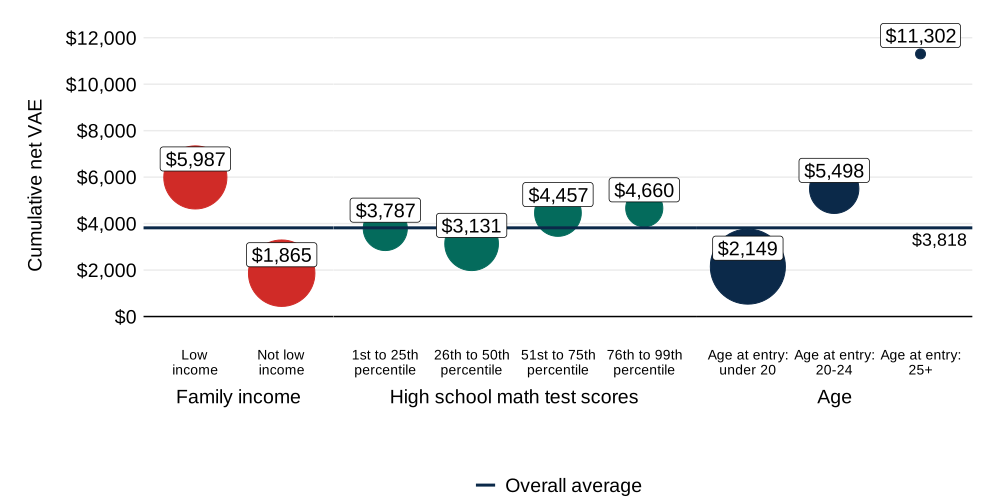
Exhibit Note: Values are averages and in 2023 dollars. The size of each circle is proportional to the number of students in the sample for each demographic cohort.